

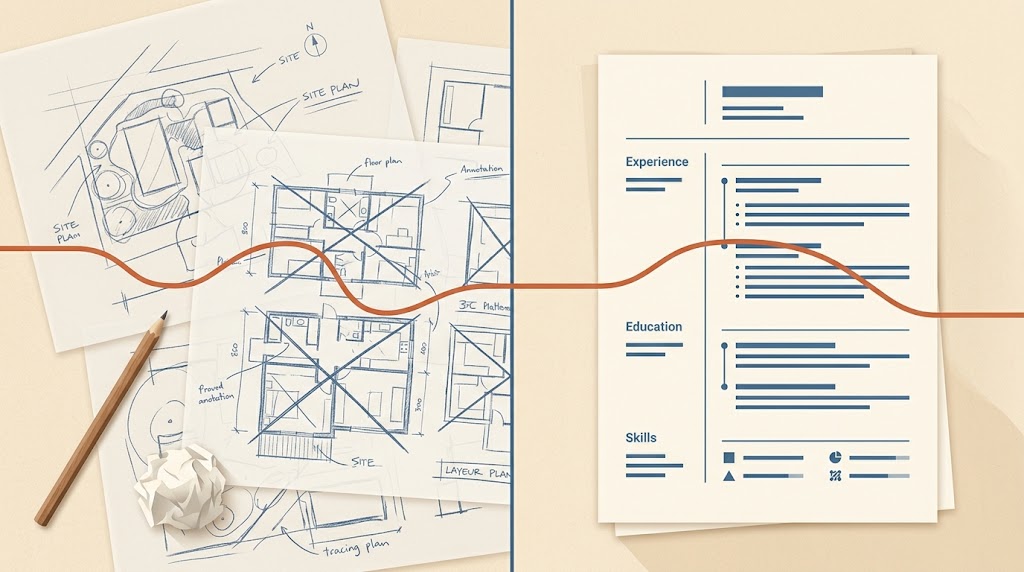
You spent a full semester on that project. Rough site sketches, abandoned layouts, a section drawing that refused to work until two in the morning. Then you open your CV and write one line: “Designed a community building using Revit.”
True, but almost empty.
Here is what most graduates miss. Your experience is not thin. It is buried under project titles, software lists and vague descriptions, so the evidence of how you think never reaches the reader.
Let’s bring it forward.
A title says what you worked on. A description says what you can do.
Architects and practice directors read graduate CVs quickly, often between meetings. In those first few seconds, they ask one thing: could this person be useful on our projects?
“Final-year housing project” cannot answer that. It hides the site you analysed, the residents’ needs you considered and the layouts you rejected along the way.
Think of your CV as the trailer and your portfolio as the film. The CV gives a fast, clear picture of your abilities. The portfolio shows the drawings and development behind it. Cram one into the other and both get weaker.
Why your own projects are so hard to describe
The better you know a project, the harder it is to explain. You remember why the entrance moved and why the first plan failed, so you shrink it all into “developed a building concept.”
Group work adds another snag. Maybe you handled the site analysis while a teammate drew the sections. A reader needs your contribution, not the team’s final result.
Then there is software. Listing seven programmes tells nobody what you can actually do. Opening Revit is not the same as building a tidy model with organised drawing sheets, and an interviewer will find that gap within two questions.
Know what the practice needs first
Your background stays the same. The emphasis changes.
A residential studio will care about housing layouts, planning constraints and the link between inside and outside. A practice designing public buildings will look harder at technical drawings, accessibility and BIM.
The same principle applies when graduates assess an Architecture CV Writing Service UK: good CV writing should make genuine experience easier to understand, not dress it up as something it isn’t.
Tailor every application. Read each job advert carefully, then adjust the order of your bullet points to bring the most relevant experience forward. Spend enough time understanding what the practice is looking for rather than sending the same version to every employer.
The Constraint–Move–Result method
This is the simplest structure for turning a vague description into a convincing one. Every strong architectural project follows the same pattern:
- Constraint: what made the problem difficult
- Move: what you decided to do about it
- Result: what changed in the design
Take a tight site with awkward pedestrian access. The weak version reads: “Completed a site analysis.”
The strong version reads: “Tested four entrance positions on a restricted urban site, then reorganised the plan so public and quiet spaces no longer competed for the same circulation route.”
Same project. Completely different impression.
Skills that deserve more than a passing mention
Don’t just list what you know. Show how you think.
Design development. Ideas that look convincing in a sketch often fall apart once circulation, structure or daylight is tested. Describe one problem you spotted and how you fixed it.
Drawing types. Skip “produced architectural drawings.” Name them: plans, sections, elevations, details, and say what each was meant to communicate.
Site understanding. Orientation, access, neighbouring buildings and noise all shape a proposal. A housing scheme beside a busy road, for example, forces decisions about entrances, private gardens and where the quiet rooms go.
Honest software detail. Revit, AutoCAD, Rhino and SketchUp do different jobs. Say which stage each one supported.
And the most underrated skill of all: being able to explain why your first idea was wrong. That shows judgement, and no software list can.
Turning a project into a CV entry
Choose two or three projects that show different strengths. One conceptual, one technical, one that shows your grasp of materials or environment. Leave out any that only have a pretty render behind them.
Here is how an entry might look:
Community Learning Centre – Final-Year Design Project
- Responded to restricted site access and dense surroundings by testing four entrance positions
- Reorganised the internal layout to separate public and quiet learning spaces
- Produced plans, sections and elevations in AutoCAD
- Built the Revit model to check spatial relationships and daylight
Notice what is missing: no claims of brilliance. Just concrete facts a reader can weigh.
Start a design log (almost nobody does)
Here is a habit that makes all of this far easier. While you work on a project, keep a one-line design log: the problem, then the change you made.
- Entrance created awkward circulation → tested alternative positions
- Back rooms received limited daylight → repositioned internal spaces and adjusted window locations to improve daylight distribution
- Garden felt disconnected → opened up the ground floor
None of this goes on your CV. It is raw material, so months later you are not trying to reconstruct your reasoning from memory.
Photograph early sketches and rejected plans too. A discarded option is often the clearest proof that you understood the problem.
The same care applies to placements. If you revised drawings or prepared presentation material, say exactly that. Small, honest responsibilities show you understand how a practice actually runs.
Mistakes that quietly cost interviews
- Leading with renders. A polished image does not prove sound planning.
- Software soup. If your Revit is basic, say basic. A claim you cannot demonstrate does damage.
- Hidden group roles. Never present team work as solo work.
- Too many projects. Three well-described entries beat eight thin ones.
- Decorative layouts. Your CV is not a presentation board. Readability comes first.
- Untested portfolio links. Test every link on both a phone and a desktop before sending. Check that the files open properly, drawings remain readable and the person reviewing your work can move between projects without difficulty.
- Blurred experience types. Keep university work, placements and paid work clearly separate.
One last check before you send
The strongest graduate CVs are not the longest. They are the clearest.
Put your CV and portfolio side by side. The CV should introduce each project, and the portfolio should prove it with drawings, models and development work.
You are applying as a graduate, and that is fine. Your education, your design decisions and your willingness to keep developing are already worth presenting.
The aim is not to make your experience look bigger. It is to make what you genuinely have impossible to overlook.